5 Warehouse Line Marking Mistakes That Create Safety Risk
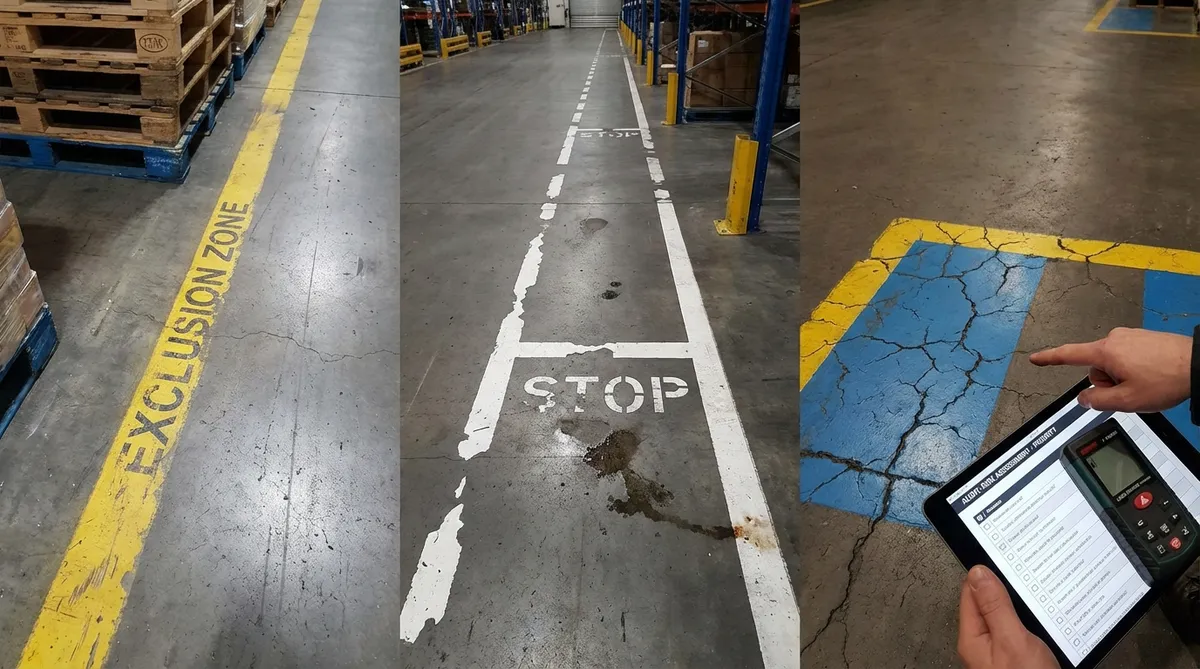
Clear, consistent line marking is a deceptively simple control that underpins safe warehouse operations. When it fails, the consequences range from near-misses and inefficient traffic flows to regulatory non-compliance and higher insurance risk. This article outlines five real-world line marking mistakes we see repeatedly, why they matter to safety managers, and exactly how a risk-based audit flags them and turns findings into a practical remarking programme.
The five real-world mistakes and how audits pick them up
1. Faded exclusion zones
What it looks like
Yellow or red exclusion areas with poor contrast against the floor
Edges fraying into the travel aisle
Previously strict no-entry areas becoming visually ambiguous
Why it’s risky
Exclusion zones signal areas where machinery operates, where loading/unloading occurs, or where pedestrians must not enter. When these zones fade, operators and pedestrians lose the visual cue that reduces exposure to moving plant — increasing the chance of collisions or unsafe access.
How audits detect it
Visual contrast checks against baseline photos and acceptable contrast thresholds
Photographic record with timestamps to show progressive fading
Mapping faded zones to nearby hazards (forklift routes, loading docks)
Risk scoring based on proximity to traffic and frequency of use
Practical fix
Upgrade to a more durable marking system (e.g. thermoplastic layer), consider high-visibility colour with UV-resistant pigments, and schedule more frequent inspections for high-use exclusion zones.
2. Inconsistent colours and palettes
What it looks like
Different shades of yellow, white and red used across the site
Hand-painted patches that don’t match corporate or safety standards
Colour coding used inconsistently between areas
Why it’s risky
Colour is a primary communication tool. Inconsistent palettes lead to confusion: staff may misinterpret a faded yellow as a non-restrictive marking, or mixed standards can slow decision-making during busy operations. In the worst case, inconsistent colours mask serious hazards.
How audits detect it
Colour consistency checks using calibrated photography or colour charts
Cross-referencing current site colours with the site’s colour standard or safety policy
Tagging instances where colour inconsistency correlates to incidents or reported near-misses
Practical fix
Standardise a site-wide colour palette, communicate the palette in safety inductions, and roll out corrective remarking in priority order (high risk first).
3. Broken or missing pedestrian paths
What it looks like
Gaps in pedestrian lanes where paint has worn away
Interrupted crosswalks at intersections or doorways
Shared-traffic areas with no clear segregation
Why it’s risky
Pedestrian segregation reduces interactions between people and vehicles. Broken paths encourage people to walk in vehicle zones or take shortcuts, increasing the likelihood of pedestrian-vehicle incidents, a leading cause of serious workplace injury in warehouses.
How audits detect it
Continuity checks to identify breaks and inconsistencies along pedestrian routes
Site walk-through with user-flow observations to see where pedestrians drift
Overlay of pedestrian paths with vehicle routes and high-density zones to measure conflict points
Practical fix
Restore continuous pedestrian paths with durable, anti-slip markings and consider physical separations (bollards, barriers) where risk scores are high. Include these priorities in the site’s remarking schedule.
4. Poor refresh cycles (too infrequent or reactive)
What it looks like
Markings only repainted after an incident or regulatory visit
No scheduled maintenance plan — only ad-hoc touch-ups
Maintenance logs that show irregular or undocumented work
Why it’s risky
Reactive maintenance increases lifetime cost and leaves high-risk defects unaddressed for longer. Without a planned cycle, markings degrade unpredictably and safety managers cannot forecast budget or minimise downtime.
How audits detect it
Review of maintenance records and last repaint dates
Correlation of wear patterns with traffic densities and operational schedules
Lifecycle modelling to estimate safe service intervals by material and location
Practical fix
Implement a documented refresh cycle based on risk and traffic (e.g. high-traffic aisles every 6–12 months, storage aisles every 12–24 months). Use an audit-backed plan to budget remarking as part of your safety capital program.
5. Illegible or cluttered markings (too much information)
What it looks like
Multiple overlapping markings in the same area
Conflicting arrows, text, and floor signs that are hard to read
Temporary tape and older markings creating visual clutter
Why it’s risky
When the floor is noisy with messages, staff can miss critical instructions. Cognitive overload slows decision-making and increases the chance of mistakes. Cluttered markings also make audits harder to interpret and erode the authority of safety demarcations.
How audits detect it
Mapping overlapping markings and identifying contradictions
Assessment of visual clarity from typical vantage points and travel speeds
User interviews or observations during peak periods to confirm confusion
Practical fix
Remove obsolete markings, simplify the marking scheme and implement a single-source control for any temporary tape or signage. Keep a clean, consistent visual hierarchy so safety-critical markings stand out.
What a good audit looks like in practice
A practical, risk-based line-marking audit is more than a checklist. Typical steps:
Site scoping and stakeholder interviews to identify high-consequence areas
Photographic capture and geo-tagging of all markings
Measured checks (width, continuity, colour contrast) against site standards
Risk scoring that combines severity (consequence) and exposure (likelihood)
Actionable remediation plan with estimates, prioritised by risk
Deliverables should be easy to act on: an exportable defect list, photographic evidence, and a recommended remarking schedule with costs and expected service life of the proposed materials.
Turning audit findings into a proactive remarking program
A well-structured program does three things:
Prioritises work by risk so limited budgets buy the biggest safety return
Defines materials and application standards to ensure longevity and consistency
Establishes inspection intervals and record-keeping to avoid reactive spending
Start with a pilot: pick a high-traffic zone, apply the recommended materials, and monitor outcomes (fewer near-misses, improved compliance). Use that pilot to scale a site-wide programme and build the business case for regular maintenance funding.
Conclusion
Faded exclusion zones, inconsistent colours, broken pedestrian paths, poor refresh cycles and illegible markings are common but preventable risks. A risk-based line-marking audit does more than catalogue faults — it translates visual defects into safety priorities and a defensible remarking programme. For safety managers, that justification is essential: it turns a maintenance chore into a measurable safety investment.